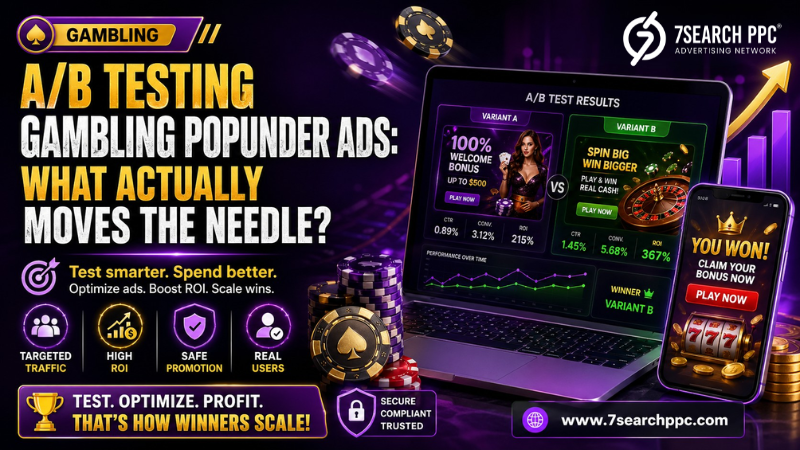
Platforms like 7SearchPPC are often used in these environments because they offer access to large volumes of cost-efficient traffic. But that accessibility also introduces variability. What works in one setup often collapses when exposed to broader traffic segments. This is exactly where structured A/B testing becomes less of an optimization tactic—and more of a survival mechanism.
The real question isn’t “what should you test?” It’s “what actually changes outcomes in gambling popunder ads when traffic quality, intent, and user context are inherently unstable?”
In gambling popunder campaigns, the variables that most consistently move performance are pre-lander messaging, offer framing, and geo-device alignment—not minor creative tweaks. Testing headline tone, bonus structure clarity, and trust signals typically produces measurable shifts in conversion rate and deposit quality, while color or layout changes rarely create meaningful impact.
What Most Advertisers Get Wrong About A/B Testing Popunder Traffic
A recurring issue is that advertisers approach popunder testing like display or native campaigns. They isolate micro-elements—button color, font size, image placement—while ignoring macro-level mismatches between traffic intent and funnel expectation.
In most campaigns, the problem isn’t that Variant A beats Variant B by 3%. It’s that both variants are fundamentally misaligned with the user’s intent when the popunder fires.
This becomes especially visible in gambling popunder advertising where:
- Users are interrupted, not actively searching
- Intent is low or undefined at entry
- Click-through does not equal interest
- Bonus-driven messaging attracts low-value traffic
Testing small UI elements in this context is like optimizing the paint on a car with engine failure.
If you're planning to run or optimize gambling popunder campaigns, accessing the right traffic environment matters. You can explore and register here.
Key Factors That Actually Move the Needle
Across most gambling popunder campaign environments, performance shifts tend to cluster around a few high-impact levers:
- Pre-lander narrative alignment (not just design)
- Offer clarity vs ambiguity
- Trust signaling under low-intent entry
- Device-specific behavioral adaptation
- Geo-specific expectation matching
Advertisers working with networks such as 7SearchPPC typically notice that when these elements are tested systematically, conversion volatility stabilizes—even when traffic quality fluctuates.
Why Pre-Landers Outperform Direct Landing Page Testing
One of the most misunderstood areas in A/B testing betting popunder ads is where the test should actually happen.
Direct-to-offer setups often underperform not because the offer is weak, but because the user isn’t contextually prepared. Popunder users didn’t “choose” to engage—they were exposed.
Pre-landers act as intent filters.
Testing variations here—especially around:
- Headline framing (urgency vs curiosity)
- Localized messaging (regional language cues)
- Bonus explanation simplicity
- Soft vs aggressive call-to-action
...often produces significantly larger performance deltas than testing the landing page itself.
At lower budgets this difference can stay hidden. At scale, it becomes the primary driver of ROI stability.
The Hidden Variable: Traffic Intent Mismatch
A major reason A/B tests fail to produce meaningful insights is that traffic intent isn’t controlled.
In sports betting popunder ads, for example, a user landing during a live match window behaves very differently from one exposed during off-peak hours. Yet many tests ignore timing as a variable.
This leads to false conclusions:
- A variant “wins” due to timing, not quality
- Scaling that variant fails under different conditions
- Optimization decisions are made on unstable data
When running a ppc campaign for gambling, controlling for traffic segmentation—time, GEO, device—is often more important than the test itself.
What Should You Test First?
Start with high-impact variables: pre-lander messaging, offer positioning, and audience segmentation. Avoid testing design-level elements until macro alignment is validated. Early-stage testing should focus on intent matching and funnel clarity, not cosmetic differences.
Creative Testing vs Message Testing: A Critical Distinction
Many advertisers confuse “creative testing” with “message testing.”
Creative testing involves:
- Images
- Colors
- Layout
Message testing involves:
- Value proposition clarity
- Bonus framing
- Trust cues
- Emotional triggers
In sweepstakes popunder ads and gambling verticals, message testing almost always outperforms creative testing in terms of measurable business outcomes.
Why? Because the user’s decision is driven by perceived value and risk—not visual aesthetics.
Device-Specific Testing: Often Ignored, Usually Critical
Popunder traffic is heavily mobile-dominant in many regions, including India. Yet many A/B tests are run uniformly across devices.
This creates distorted insights:
- Mobile users respond better to shorter flows
- Desktop users tolerate more information density
- Load speed impacts mobile conversions disproportionately
In lower-cost traffic environments (e.g., via 7SearchPPC), this difference becomes even more pronounced because user patience is lower and bounce sensitivity is higher.
Offer Framing: The Most Underestimated Lever
Offer framing is where many campaigns either unlock profitability—or quietly bleed budget.
Two offers can be identical in value but perform very differently based on presentation:
- “Get 100% bonus” vs “Double your first deposit”
- “Instant withdrawal” vs “Fast payouts guaranteed”
- “Play now” vs “Start winning today”
A/B testing here is not about wording—it’s about perceived friction and reward clarity.
Many operators underestimate how quickly low-quality traffic is attracted by vague or overly aggressive bonus messaging, leading to deposit-quality distortion.
Scaling vs Testing: Where Most Campaigns Break
A test that “wins” at $50/day often fails at $500/day.
This is not a testing failure—it’s a scaling failure.
As budgets increase:
- Traffic sources expand
- Quality consistency drops
- User intent becomes more diluted
What looked like a strong variant was often just well-matched to a narrow traffic slice.
This is why advertisers using a premium gambling ad network like 7SearchPPC often shift from simple A/B testing to segmented testing frameworks at scale.
Quick Answer: Why Do Most A/B Tests Fail in Popunder Campaigns?
Most tests fail because they isolate variables without controlling traffic conditions. Without stable segmentation (GEO, device, timing), results reflect traffic fluctuations rather than true performance differences. Effective testing requires isolating both the variable and the audience context.
What Looks Like Optimization—but Isn’t
Some patterns consistently mislead advertisers:
- Short-term CTR spikes mistaken for performance improvement
- Higher registration rates masking lower deposit quality
- Bonus-heavy messaging inflating low-value user acquisition
- Cheap traffic sources appearing profitable before churn is visible
These signals often delay real optimization because they create the illusion of progress.
Practical Testing Framework for Gambling Popunder Ads
A more reliable approach typically follows this sequence:
- Segment traffic first (GEO, device, timing)
- Test pre-lander messaging (intent alignment)
- Validate offer framing (clarity vs hype)
- Measure deposit quality, not just conversions
- Scale only after consistency appears
This framework reduces noise and ensures that test outcomes reflect actual performance improvements rather than environmental randomness.
Final Observation: The Real Lever Is Alignment, Not Variation
In most popunder traffic for gambling campaigns, the difference between losing and profitable setups is not how much you test—but what you choose to test.
A/B testing works when it’s used to align traffic, message, and expectation—not when it’s used to chase marginal gains on already misaligned funnels.
Once that alignment is achieved, even small variations start to matter. Until then, they rarely do.
Frequently Asked Questions (FAQs)
How long should an A/B test run in gambling popunder campaigns?
Ans. Tests should run long enough to reach consistent behavioral patterns, not just statistical significance. In most cases, this means at least several thousand impressions per variant across stable traffic segments. Short tests often reflect traffic volatility rather than true performance differences.
What is the biggest mistake in testing gambling popunder ads?
Ans. The most common mistake is testing design elements before validating funnel alignment. If the traffic intent and offer positioning are mismatched, no amount of UI optimization will produce sustainable improvements.
Should you prioritize CTR or conversion rate in popunder testing?
Ans. Conversion quality should always take priority. High CTR can be misleading in popunder environments because clicks are often accidental or low-intent. Deposit rate and user value are more reliable indicators of success.
Can the same winning variant work across all GEOs?
Ans. Rarely. Different regions respond to different messaging, trust signals, and bonus structures. A variant that performs well in one GEO may underperform elsewhere due to cultural and behavioral differences.
When is the right time to scale a tested campaign?
Ans. Scaling should only begin after performance stability is observed across multiple traffic segments. If results fluctuate heavily with small traffic changes, the campaign is not yet ready for budget expansion.